

Choosing a Ford SUV for daily driving becomes easier once you understand what separates trail-built capability from everyday comfort, and where the two actually overlap. Many shoppers arrive at the lot drawn by the bold styling of the Bronco or the rugged stance of the Bronco Sport, and they leave questioning whether that capability comes at the cost of a smooth commute or practical family space. The Ford lineup answers that question differently depending on which model you sit behind. However, matching the right SUV to your real routine means looking past the exterior and understanding what the hardware actually does when you are driving Tennessee highways, rural two-lanes, or the occasional gravel trail. The Explorer, Bronco, Bronco Sport, and Expedition each serve a different kind of driver, and knowing the structural and functional differences helps you choose with confidence rather than compromise.
What Rugged Capability Means Across the Ford SUV Lineup
Rugged is not a single measurement. Across Ford’s SUV family, capability spans a wide range from purpose-built off-road architecture to trail-styled daily drivers to family platforms with available off-road packages. Understanding where each model sits on that spectrum is the first step in deciding whether rugged capability is something you will use, something you want available occasionally, or simply a design preference that does not need to drive your purchase decision.
The Ford Bronco sits at the most committed end of the range. Its body-on-frame construction, solid front axle on select trims, locking differentials, and G.O.A.T. mode system are purpose-built for demanding terrain. G.O.A.T. stands for Goes Over Any Type of Terrain, and the seven selectable drive modes adjust throttle response, traction control thresholds, and differential behavior for conditions ranging from sand to rock to mud. Trail Control is Ford’s low-speed off-road cruise control, holding a set speed over rough ground so the driver can focus on steering input rather than throttle modulation. These are genuine mechanical systems, not appearance packages, and they reflect the engineering priorities of a vehicle designed first for the trail. That engineering orientation also shapes how the Bronco behaves every other day of the week.
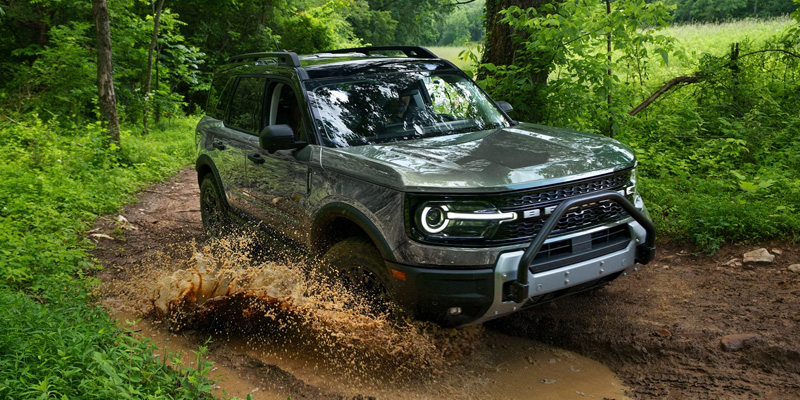
The Bronco Sport occupies a different position. Built on a unibody platform shared with the Escape, the Bronco Sport carries rugged exterior styling and genuine off-road credibility, but its architecture prioritizes everyday driving composure. The available off-road-tuned suspension, Mud and Ruts mode, and trail-specific traction management give it real trail usefulness beyond what most crossovers offer. Furthermore, the Big Bend, Outer Banks, Badlands, and Wildtrak trims each move the capability needle differently, letting you select how much hardware you actually need. The following overview maps where each Ford SUV lands across the capability spectrum:
- Ford Bronco: body-on-frame construction with locking differentials, Trail Control, and G.O.A.T. modes tuned for committed off-road driving. It is the most capable daily driver in the lineup, though its trail-first architecture shapes its on-road personality.
- Ford Bronco Sport: unibody platform with available Badlands off-road suspension and terrain-specific drive modes. It is genuinely capable on light to moderate trails while delivering noticeably smoother pavement manners than the full Bronco.
- Ford Explorer Tremor: a family-oriented midsize platform with a factory suspension lift, all-terrain tires, a limited-slip rear differential, and trail-ready hardware. It is designed for shoppers who want real capability without leaving the family SUV footprint.
How Platform Architecture Shapes Every Drive
The single most consequential technical difference between the Bronco and the rest of the Ford SUV family is the platform beneath the body. That structural choice ripples through fuel economy, ride quality, highway composure, and noise levels in ways that matter every day, not just on trail days.
Body-on-frame construction, which the Bronco uses, separates the body from the chassis through a rigid mounting system. This design excels at handling the lateral and vertical stress of off-road terrain, protects drivetrain components, and gives the Bronco a higher towing and payload tolerance relative to its size. On pavement, however, body-on-frame vehicles tend to transmit more road vibration and noise into the cabin, require more driver engagement at highway speeds, and return lower fuel economy figures because the heavier structure carries more curb weight. The Bronco’s 2.3-liter EcoBoost base engine returns EPA estimates in the mid-20s combined. For someone commuting 30 to 40 miles daily on US-70 or TN-55, that translates to a real fuel cost difference over the ownership period.
The Explorer, Bronco Sport, and Escape all use unibody construction, where the body and frame are integrated into a single structural unit. This approach reduces weight, lowers the vehicle’s center of gravity, and smooths how road inputs travel through the suspension into the cabin. The result is noticeably quieter highway cruising, less steering correction needed at speed, and better fuel returns. The Explorer’s 2.3-liter EcoBoost achieves up to 28 miles per gallon on the highway. The Bronco Sport’s lighter footprint brings the base 1.5-liter EcoBoost up to a similar highway figure. For a driver who primarily navigates Morrison’s surrounding two-lanes, runs errands in McMinnville, or commutes toward Sparta, that composure difference is felt on every trip. The available BlueCruise hands-free highway driving system on select Explorer trims adds another layer of long-road ease that the Bronco does not offer.
None of this makes the body-on-frame Bronco a poor daily driver. It is far more composed on pavement than its off-road capability might suggest. However, the difference is real, and shoppers who prioritize quiet cabins, refined highway feel, and fuel efficiency will find the unibody alternatives more naturally suited to the majority of their driving.
Seating and Cargo Structure Matched to How Your Household Actually Moves
Seat count and cargo volume on a spec sheet are starting points, not conclusions. The way those numbers translate to real family loading, including car seats, strollers, sports equipment, groceries, and camping gear, depends on the configuration architecture, how rows fold, and what the second and third rows actually deliver for adult passengers rather than just seat count totals.
The Ford Explorer‘s three-row, seven-passenger architecture is the most broadly practical for growing families. Second-row width comfortably fits two car seats side by side, and third-row access uses a walk-in entry through the second row that is easier to manage than some competitors. Behind the third row, 16.3 cubic feet of cargo space handles a moderate grocery run or a couple of overnight bags. Fold the third row flat and that expands to 46 cubic feet, which is genuinely useful for sports equipment or weekend hauls. With both rows folded, 85.8 cubic feet opens the Explorer to cargo tasks well beyond what most families expect from a midsize SUV. The 2026 Tremor trim adds a sport-utility dimension to that family footprint through a factory suspension lift, all-terrain tires, and additional ground clearance, letting a family that also wants trail access find it in a single vehicle.
The Ford Expedition scales that concept for larger households. Seating for up to eight across three rows, 20.9 cubic feet behind the third row, and a maximum 104.6 cubic feet with all rows folded covers the largest cargo demands in Ford’s lineup. The Expedition Max extends the wheelbase for even greater third-row headroom and rear cargo volume, which is a meaningful choice for families whose camping trips or road trips require hauling volume that would otherwise mean pulling a trailer. Moreover, the Expedition’s towing capacity reaches 9,600 pounds, which covers boats, camper trailers, and cargo setups common across Middle Tennessee’s outdoor recreation culture. The Bronco Sport, by contrast, fits two rows and five passengers across a significantly shorter footprint. Its cargo area emphasizes smart storage over raw volume, with features like a hands-free tailgate, underfloor bins, and load-in hooks that make it practical for active-lifestyle gear without the size of a three-row platform.
- Ford Explorer cargo configuration: 16.3 cubic feet behind the third row, 46 cubic feet with the third row folded, and 85.8 cubic feet with both rows flat. This structure works well for families who need to switch between passenger and cargo modes regularly throughout the week.
- Ford Expedition and Expedition Max cargo configuration: up to 104.6 cubic feet of maximum volume with all rows folded, plus class-leading towing capacity up to 9,600 pounds. This suits families whose hauling needs go beyond the school-run-and-grocery-store routine.
- Ford Bronco Sport cargo layout: a two-row, five-passenger footprint with smart active-lifestyle storage solutions. It is practical for smaller households or drivers who want trail-ready versatility in a compact package rather than three-row family capacity.
What Capability Looks Like When You Rarely Leave the Pavement
One of the most underserved groups in the Ford SUV conversation is the shopper who genuinely wants capability available for the occasional gravel road, the camping trip twice a year, or the unexpected weather event, but whose daily reality is school carpool, highway commuting, and weekend errands. This buyer does not need the full Bronco hardware stack. However, they also do not want to find themselves under-equipped when the moment arrives.
The 2026 Ford Explorer Tremor is built precisely for this buyer. On the platform level, it remains the family-first, unibody Explorer that parents already trust for everyday driving. The Tremor package layers factory hardware on top of that foundation: a suspension lift of 0.6 inches adds ground clearance, Goodyear Wrangler Territory all-terrain tires handle mixed surfaces without the rough road noise of extreme off-road rubber, a limited-slip rear differential manages traction on loose or slippery ground, and Trail Turn Assist improves low-speed maneuverability on narrow trails by braking the inside rear wheel into a tighter arc. The result is an Explorer that drives to school every day, seats seven, and still navigates the kind of terrain that Middle Tennessee’s back roads and recreation areas occasionally demand, all without requiring the driver to manage a trail-specific vehicle on the way to work.
The Bronco Sport Badlands trim serves a similar role for smaller households. Its available off-road suspension, rear hydraulic bump stops for aggressive terrain absorption, and Mud and Ruts drive mode provide more genuine trail hardware than any standard crossover. Because the Bronco Sport’s footprint is compact, it also fits comfortably in standard parking structures and neighborhood streets where the full Bronco’s width and turning radius can feel like more vehicle than the situation requires. For a driver who values rugged aesthetics and occasional capability without committing to dedicated off-road architecture, the Badlands trim offers a well-calibrated middle ground.
Using Trim Logic to Right-Size Your Decision
Trim levels across Ford’s SUV lineup are not simply ascending lists of features. They reflect different intended use profiles. Understanding the hardware logic behind each tier helps you avoid paying for off-road capability you will not use, or conversely, under-speccing when you genuinely want it available.
On the Bronco Sport, the Big Bend and Outer Banks trims address shoppers who want the rugged exterior and capable all-wheel drive system for occasional unpaved roads and light weather variety. The Badlands trim introduces serious off-road hardware, including the advanced 4WD system with Mud and Ruts mode, off-road-tuned suspension, and rear hydraulic bump stops, for shoppers who will genuinely take the vehicle onto graded gravel, forest service roads, or muddy campsite approaches. The Wildtrak sits between them in daily comfort orientation while adding exterior trail utility. A shopper who identifies capability as occasional and weather-event-driven will find Outer Banks the more balanced choice, while a shopper whose weekends regularly involve trails should start at Badlands.
On the Explorer, the XLT and ST-Line trims address the core family SUV buyer focused on space, tech, and comfort. The ST trim’s turbocharged 3.0-liter V6 producing 400 horsepower serves driving-experience-focused buyers who do not need off-road hardware but want power headroom on highway passes and merges. The 2026 Tremor trim serves the family buyer who also needs genuine capability without a separate vehicle. Trim selection here is also a question of technology priorities: BlueCruise, available on Platinum and ST trims, becomes meaningful for shoppers who log significant highway miles toward McMinnville or regularly drive the I-24 corridor. Furthermore, selecting the right trim for actual use avoids the common pattern of paying for Wildtrak or Badlands hardware on a Bronco Sport primarily used for school pickup and grocery runs, or over-speccing into Explorer ST horsepower when Tremor capability is the actual need.
Every trim decision comes back to one honest question: what does your driving week actually look like? The Ford lineup at Reddick Brown Ford in Morrison is broad enough that the answer to that question has a clear match, without over-reaching into capability you will not use or under-speccing into comfort that leaves you short when it matters.
Connect with us


Recent Blog Entries
- How to Connect Ford SYNC: Apple CarPlay Setup Guide
- Ford SUV for Daily Driving: Matching Rugged to Real Life
- Ford Trucks for Drivers Who Like VelociRaptor, Shelby, and Baja-Style Capability
- Ford Truck vs SUV: Which Fits Your Lifestyle?
- Best Ford SUVs for Growing Families Space Safety and Everyday Usability